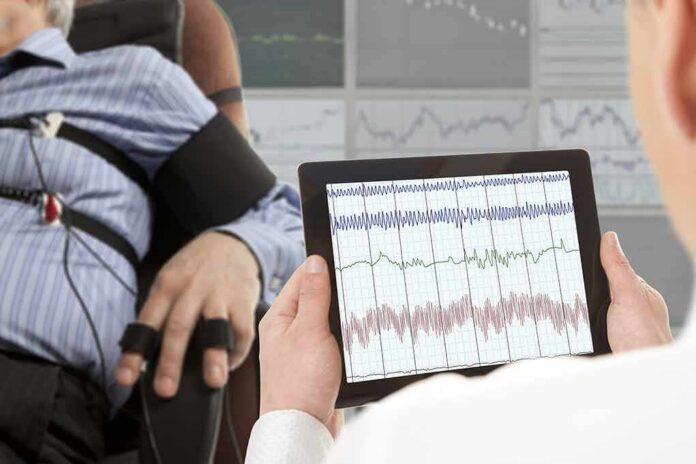
A single heartbeat trace, run through an artificial intelligence model, may soon warn you about diabetes before a single drop of blood gets drawn.
Quick Take
- Japanese researchers built an AI model called DiaCardia that spots prediabetes using only electrocardiogram (ECG) data.
- The model works with standard 12-lead ECGs and also single-lead readings, the kind a smartwatch can capture.
- Internal testing showed strong accuracy, but the technology has not replaced blood tests as the medical standard.
- Doctors still diagnose prediabetes using blood sugar tests, and experts say more real-world study is needed before ECG screening goes mainstream.
A Heart Signal That May Flag Blood Sugar Trouble
Researchers at the Institute of Science Tokyo say they built the first AI model that reliably spots prediabetes from ECG data alone. The team, led by Junior Associate Professor Chikara Komiya, calls DiaCardia interpretable and generalizable, meaning it explains its reasoning and works across different patient groups, not just the one it trained on.
The model does not need a full hospital-grade ECG rig either. It performs nearly as well using single-lead data, the simplified signal a modern smartwatch already records. That detail matters because it opens the door to screening people during a normal day, not just during a scheduled clinic visit.
The Numbers Behind The Claim
In internal testing, the model reached an area-under-curve score of 0.851, a statistic researchers use to judge how well a test separates sick from healthy people. A perfect score is 1.0, so 0.851 puts DiaCardia in strong territory for a screening tool, though not flawless. Japanese wire reports on the same research described roughly 85 percent accuracy identifying high-risk individuals from health-checkup data collected on about 16,000 people in Tokyo.
The researchers say the AI picks up tiny changes in heart muscle activity that show up before blood sugar problems become obvious. Professor Tetsuya Yamada’s team trained the system by comparing ECGs from people flagged as prediabetic or diabetic against those with normal blood sugar, then let the model learn the pattern differences on its own.
Why Blood Tests Still Rule The Diagnosis
None of this replaces the current medical rulebook. The American Diabetes Association still defines prediabetes using specific blood measurements: hemoglobin A1c between 5.7 and 6.4 percent, fasting glucose between 100 and 125, or a two-hour glucose tolerance result between 140 and 199. Those thresholds remain the official diagnostic standard, and DiaCardia has not been positioned to overturn them.
That gap matters for anyone tempted to treat a smartwatch reading as a diagnosis. DiaCardia was tested in a retrospective study, meaning researchers analyzed existing records rather than tracking new patients forward in real time to see how the tool performs in daily practice. A commentary on the research noted that its real-world impact still depends on further study design and controlling for other health factors that could muddy results.
What Still Needs Proving Before Wearables Take Over
Independent researchers reviewing similar ECG-based diabetes tools have flagged a recurring problem across this whole field: strong results in one dataset don’t always hold up when tested on different populations, devices, or health systems. A systematic review of non-invasive ECG diabetes detection models found real potential but also called current research limited in scope. That is not a knock on DiaCardia specifically, but it is the exact hurdle any new screening tool must clear.
Cardiologists have chased this idea before. Earlier ECG-AI projects, including one tested on a Quebec health registry, reported promising diabetes-detection scores years ago, yet none of them displaced blood testing as the clinical gold standard. DiaCardia’s backers frame their work as more robust and interpretable than prior attempts, but that claim will be tested the same way every medical breakthrough gets tested: through independent replication, larger and more diverse patient groups, and years of real-world use before any regulator or doctor treats it as a substitute for a lab result.
The Bigger Picture For Everyday Health Screening
For readers over 40 already juggling annual physicals, cholesterol panels, and A1c checks, the appeal is obvious. A wristwatch that quietly flags rising diabetes risk without another needle stick sounds like the future arriving early. Common sense says treat this as a promising early signal worth watching, not a green light to skip blood work your doctor still relies on. The science is moving fast. The proof required to change medical practice moves, appropriately, much slower.
Expect more headlines like this one as wearable makers race to add health-risk features beyond step counts and heart rate. The real test will be whether these tools survive scrutiny outside a single Tokyo hospital dataset, across different ages, ethnic groups, and devices, before anyone bets their health on a heartbeat instead of a blood draw.
Sources:
mindbodygreen.com, window-to-japan.eu, sciencedirect.com, ncbi.nlm.nih.gov, pedsendo.org