Hundreds of Americans now claim the blockbuster weight-loss drugs that trimmed their waistlines also stole their sight.
Story Snapshot
- Federal judges consolidated NAION vision-loss claims into a dedicated multidistrict litigation.
- Plaintiffs say drugmakers failed to warn about a rare eye “stroke” that can cause blindness.
- Manufacturers deny causation and point to pooled trials showing no added risk.
- Europe’s regulators flagged NAION as a very rare side effect, adding fuel to U.S. lawsuits.
What triggered this litigation wave
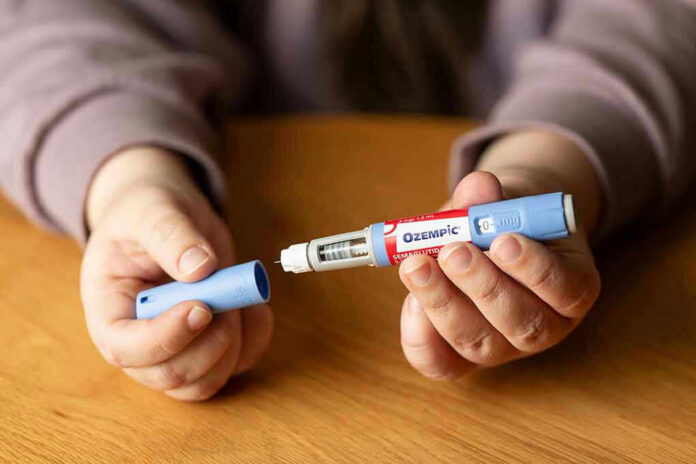
Patients who used Ozempic, Wegovy, Mounjaro, and Zepbound filed lawsuits alleging a rare optic nerve injury called non-arteritic anterior ischemic optic neuropathy, or NAION. They say the companies, Novo Nordisk and Eli Lilly, failed to warn doctors and users about vision loss risk. Reports describe more than one hundred federal cases and many more in state courts, with filings tied to sudden, permanent changes in vision after starting these drugs. A federal case tracker shows a dedicated vision-loss proceeding.
The federal judiciary grouped these NAION claims into a separate multidistrict litigation in the Eastern District of Pennsylvania, apart from earlier stomach-injury cases tied to the same drug class. Consolidation signals a high volume of similar claims and a need for coordinated discovery and expert review. Plaintiffs argue labels lagged behind real-world safety signals and that earlier warnings could have prompted eye exams or stop-use instructions that might have reduced harm.
What the companies say and why it matters
Novo Nordisk and Eli Lilly reject the core allegation. They cite a strong overall safety record across many trials and years of use. Novo Nordisk points to pooled, company-funded analyses that did not show a higher rate of NAION compared with placebo. A spokesperson said the lawsuits lack merit and that the total picture does not prove a causal link. Eli Lilly says it actively tracks safety data and continues to review eye-related reports.
Defense lawyers will lean on randomized data and broad surveillance to argue the drugs do not cause NAION. Plaintiffs will stress timing, adverse-event patterns, and newer studies that suggest a signal. This clash is familiar in mass torts: industry touts large, controlled trials, while patients point to real-world outcomes that trials may miss. Juries often weigh whose data feels closer to lived experience and common sense about risk communication.
What regulators and researchers have flagged
European regulators reviewed the available evidence and concluded that NAION can occur as a very rare side effect of semaglutide, the active ingredient in Ozempic and Wegovy. They advised that it may affect up to one in 10,000 people using these medicines, and they updated product information to reflect that risk. That action does not settle U.S. causation, but it raises the bar for what “adequate warning” should look like in labels and marketing here.
U.S. coverage has highlighted both the rarity of NAION and the severity of the outcome. Optic nerve damage can strike fast and lead to permanent vision loss. Media summaries describe lawsuits centered on sudden-onset symptoms, often within weeks or months of starting a glucagon-like peptide-1 receptor agonist. Reporters have tracked federal filings crossing the hundred-case mark, with additional clusters in state courts and ongoing case additions.
How to think about risk, duty, and warning
NAION is uncommon, but millions now take these drugs. Even a small added risk can produce many cases across a large population. That math is why product warnings matter. A drug may help many people, and a label can still do more to spotlight a severe, if rare, risk. When the cost of a miss is blindness, the benefit of a clear, early warning is obvious to anyone who signs the pharmacy slip.
🚨 GLP-1 “blindness” lawsuits are now piling up.
Patients are suing the makers of Ozempic, Wegovy and other GLP-1 drugs, alleging they developed NAION—a potentially permanent form of vision loss.
This deserves serious attention. Nothing in medicine is free.
But we also need…
— Dr. Gator (@DrJoelGator) September 24, 2026
Courts will test several questions. Did companies know or should they have known about a safety signal before labels changed anywhere? Did they share enough with prescribers to trigger eye checks or a stop rule at first symptoms? Did patients receive fair notice in plain language, not buried in jargon? Plaintiffs must prove more than fear; they must tie specific failures to real harm. Defendants must show that their science and warnings met the duty of care at each step.
Sources:
aljazeera.com, robertkinglawfirm.com, news.sbs.co.kr, usatoday.com, reviewofoptometry.com, indiatoday.in, ema.europa.eu