An American doctor walked out of a Berlin hospital Ebola-free after just two weeks — but the real story is what doctors still cannot tell you about how he got better.
Story Snapshot
- Dr. Peter Stafford, a US doctor infected with a rare Ebola strain, was admitted to Berlin’s Charité university hospital on May 20, 2026, and discharged after roughly two weeks of treatment.
- A Charité doctor publicly called the combined antiviral therapy “very beneficial,” and the hospital confirmed symptoms “subsided significantly” during treatment.
- The Ebola strain involved is Bundibugyo, a rarer and less deadly variant than the Zaire strain — with intensive care alone capable of cutting fatality rates to as low as 10-20%.
- No public data on the specific drugs used, dosages, or viral-load trends has been released, making it impossible to separate the drug effect from the benefit of world-class intensive care.
A US Doctor Flown to Berlin for the World’s Best Ebola Care
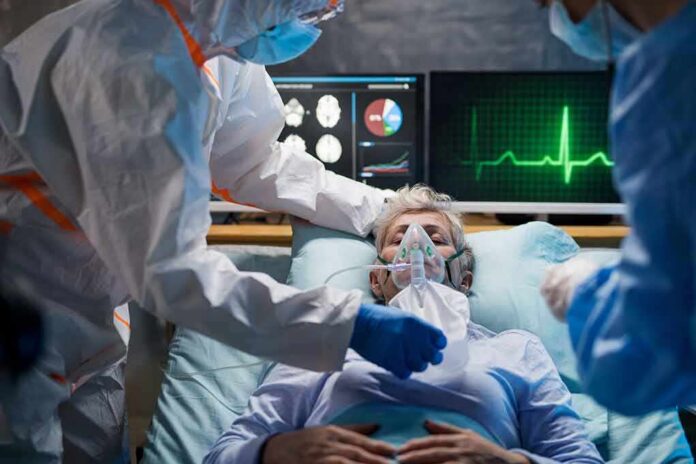
Dr. Peter Stafford contracted Ebola in the Democratic Republic of Congo and was airlifted to Germany for a reason. Berlin’s Charité university hospital runs one of the world’s most advanced isolation units for high-consequence infectious diseases. The German Federal Ministry of Health confirmed he was placed in that specialized ward on May 20, 2026. Within about two weeks, he walked out symptom-free. That outcome is genuinely good news. The question worth asking is: what exactly made the difference?
The Charité treating team gave the drug combination credit. A hospital doctor stated on camera that the experimental drug regimen was “very beneficial.” The hospital’s own statement confirmed that symptoms “subsided significantly” under combined antiviral therapy plus supportive medical care. That language is careful and worth noticing. It does not say the drugs cured him. It says symptoms improved while he was receiving both drugs and intensive support — two very different things.[4]
Why the Bundibugyo Strain Changes the Math
Not all Ebola is equally deadly. The Zaire strain kills up to 90% of those infected without treatment. The Bundibugyo strain, which is what Stafford contracted, has a baseline fatality rate of roughly 30-50%. Charité virologist Günther Schönrich noted that with intensive care unit support, that rate can drop to around 10-20%.[1] That is a massive reduction — achieved with no experimental drugs at all. Knowing that, a single patient’s recovery cannot prove the drugs did the heavy lifting. The intensive care unit may have done most of the work.[5]
This is not a reason to dismiss the drug claim. It is a reason to hold it to a fair standard. Ebola treatment history is full of moments where a survivor’s story became a drug headline before the data caught up.[3] The doctors at Charité are serious professionals working in a world-class setting. Their clinical judgment deserves respect. But “very beneficial” from a bedside doctor and “proven effective” from a clinical trial are not the same statement, and conflating them does patients and the public a disservice.
What the Public Record Is Still Missing
No public report has named the specific drugs used, the doses given, or the timeline of when they were started relative to symptom onset. Reports describe “combined antiviral therapy and additional supportive care” without separating which part drove recovery.[8] There is no published viral-load data, no adverse event record, and no comparison to other Bundibugyo patients treated with supportive care alone. That information gap is not unusual for a single emergency case, but it does mean the “very beneficial” claim rests entirely on one doctor’s observation with no objective numbers behind it.[4]
The broader pattern here is familiar and worth naming plainly. In outbreak situations, hospitals and governments face pressure to reassure the public fast. A recovering patient is a powerful story. The German Federal Ministry of Health’s public communications focused on isolation protocols and population risk, not treatment specifics.[2] That is understandable from a public health standpoint. But it leaves the drug claim floating without the kind of documentation that would actually help the next Ebola patient, or the next outbreak response team deciding what to stock in their pharmacy.
The Right Takeaway From One Man’s Recovery
Dr. Stafford is alive and free of symptoms. That matters enormously, both to him and to everyone watching this outbreak. The Charité team’s work deserves genuine credit. But the honest lesson here is not that a drug combination has been proven to beat Ebola. The honest lesson is that a world-class isolation facility, aggressive supportive care, a less lethal Ebola strain, and possibly a helpful drug regimen together produced a good outcome. Sorting out which factor mattered most requires data that has not been made public. Until it is, the headline is a hopeful story — not a medical verdict.[8]
Sources:
[1] YouTube – Doctor at Berlin hospital which treated US Ebola patient says drug …
[2] YouTube – Why a US Ebola patient is in Berlin and what makes this strain so …
[3] Web – FAQs on the Ebola outbreak in Africa in May 2026 | BMG
[4] Web – Law, Medicine, and Public Health Preparedness: The Case of Ebola
[5] YouTube – Doctor at Berlin hospital which treated US Ebola patient says drug …
[8] Web – A US doctor infected with a rare Ebola strain in the Democratic …