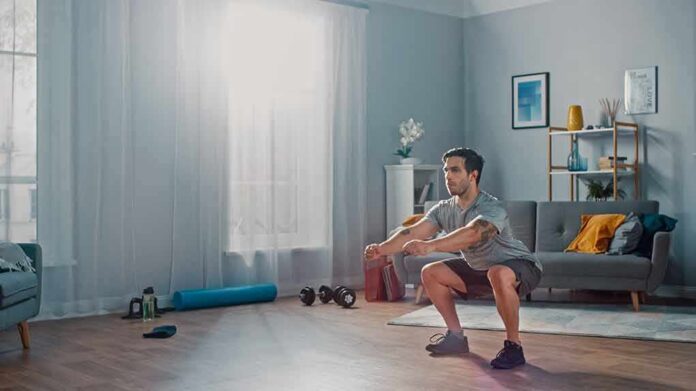
Small changes in foot angle, stance width, and how far knees travel can decide whether a squat builds strength or wears down a knee.
Quick Take
- Peer-reviewed biomechanical reviews link small form cues to real changes in knee stress and injury risk.
- Turning the toes out slightly can lower knee valgus, the inward knee collapse tied to injury.
- Stance width, trunk angle, and squat depth should match the lifter’s body and any pain history.
- Experts agree on general principles but adjust specific cues for people with knee or back pain.
What The Research Actually Shows About Squat Form
A 2024 biomechanical review published through the International Journal of Sports Physical Therapy lays out clear, testable form adjustments. For people with patellofemoral pain, meaning pain around the kneecap, the review recommends avoiding deep squats and rotating the toes outward. That outward toe angle “decreases knee valgus moment,” according to the study, which means less inward knee stress during the lift.
The same review goes further, stating that regardless of whether a squat leans more on the hips or the knees, lifters should promote some degree of toe-out to avoid harmful twisting forces at the knee joint. That is not a vague suggestion. It is a specific, measurable cue drawn from motion analysis, not gym folklore passed down from a old coach.
Stance, Depth, And Trunk Angle Matter Too
Beyond toe angle, the research points to stance width and trunk position as tools lifters can adjust. Wider stances, combined with more forward trunk lean, shift work toward the hips. Narrower stances with an upright trunk shift more load to the knees. A trunk-to-shin angle greater than 10 degrees is tied to hip-focused mechanics useful for certain rehab phases.
Other reviews reinforce a similar baseline. One clinical review recommends a natural foot position around shoulder-width, full squat depth, an upright trunk, and unrestricted forward knee movement as the general standard for healthy lifters. Another adds that feet should stay flat, toes point forward or slightly out by no more than 10 degrees, and knees should track in line with the toes throughout the movement.
One Size Does Not Fit Every Lifter
Squat research does not point to a single perfect form for everyone. Reviews repeatedly frame ideal technique as conditional on the lifter’s goals, anatomy, and injury history. That is why one paper tells patellofemoral pain patients to limit depth, while another calls full-depth squatting safe and even protective for healthy knees when technique stays sound.
A simple five-point checklist from a physical therapy source captures the common ground across these studies. Brace the core to protect the lower back. Squat to a depth you can control. Keep knees tracking in line with the feet. Keep weight centered over the middle of the foot. Choose a stance width that fits your own hip structure, not someone else’s Instagram video.
Why This Matters For Everyday Lifters Over 40
For readers past 40, these small tweaks carry real weight. Joint recovery slows with age, and repeated bad mechanics compound faster than they did at 25. A slight toe-out, a stance adjusted for hip width, and controlled depth are not cosmetic changes. They are practical, low-cost ways to keep squatting productive instead of destructive over years of training.
None of this requires a personal trainer’s certification to apply. It requires paying attention to where the knees travel, how the feet sit, and whether depth feels controlled rather than collapsed. The research backs a common-sense conclusion: form details that seem minor on video actually move the needle on long-term joint health and strength gains alike.
The takeaway is not complicated. Squats reward attention to detail, and the details that matter most are the ones science has already measured. Toe angle, stance width, depth, and trunk position are not arbitrary coaching cues. They are adjustable levers tied to actual joint stress, and getting them right pays off with every rep.
Sources:
youtube.com, pmc.ncbi.nlm.nih.gov, research.vu.nl, journals.sagepub.com, nasm.org, health.clevelandclinic.org, journals.lww.com