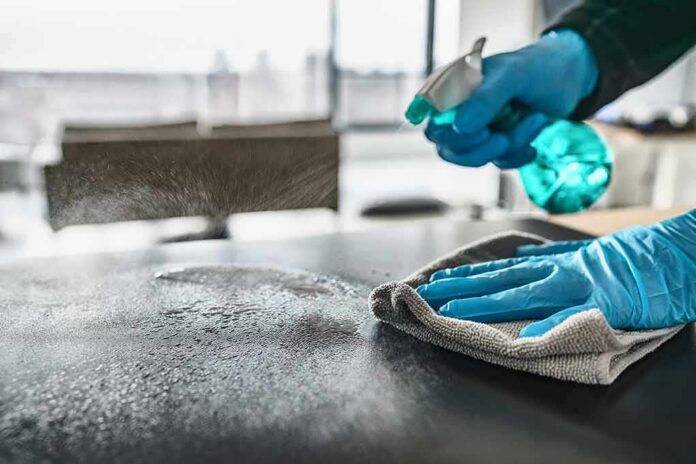
The lemon-fresh scent you love after mopping your kitchen floor may be filling your home with billions of invisible particles small enough to reach deep into your lungs.
Story Snapshot
- Purdue University researchers found scented cleaners react with indoor ozone to form nanoparticles within minutes.
- The reaction happens with both conventional cleaners and “natural” botanical or essential oil-based products alike.
- Particle doses in some tests matched or beat levels found standing near heavy traffic or a busy road.
- Scientists say opening windows and using exhaust fans can cut the exposure while cleaning.
What The Research Team Actually Found
A team led by Brandon Boor, an assistant professor of civil and construction engineering at Purdue University, tested cleaning routines inside a model home. They mopped floors, sprayed counters, and wiped surfaces with scented products. Within minutes, fragrance compounds released into the air began reacting with ozone already present indoors, sparking a fast chemical chain reaction.
That reaction does not just create a pleasant smell. It builds nanoparticles so small they measure only a few nanometers across, sometimes called nanocluster aerosol. These particles form by the billions, and in some tests by the trillions, according to the research team’s measurements taken directly in the breathing zone of a person cleaning.
Why Terpenes Are The Hidden Trigger
The chemical culprits are terpenes, natural oily compounds that give cleaning products their citrus, pine, or floral aromas. Terpenes react easily with ozone floating in ordinary indoor air, and that reaction kicks off a chain of radical chemistry that ultimately produces the ultrafine particles researchers detected. This happens whether the bottle says “natural” or not, since botanical and essential oil-based cleaners use the same reactive compounds as conventional brands.
Boor’s team says the resulting pollution can rival what people breathe outdoors near city traffic. One summary of the findings described inhaled particle doses “comparable to standing near heavy traffic,” a striking comparison for something happening inside a person’s own kitchen. Other researchers on the project noted the nanoparticle output can match or exceed emissions from gas stoves and car engines for the smallest particle sizes measured.
This Fits A Pattern Scientists Have Tracked For Decades
This is not a brand-new discovery of chemistry itself. Researchers have documented ozone-terpene reactions producing secondary pollutants like formaldehyde and ultrafine particles in indoor air studies for more than twenty years. What Boor’s team adds is a sharper, more direct measurement of how much pollution ordinary household cleaning generates in real time, and how quickly it builds up during a routine chore most families do every week.
What This Means For The Smallest Particles
Size matters here more than concentration alone. Particles under three nanometers wide can slip past the body’s natural defenses and travel deep into lung tissue, according to Purdue’s broader air quality research. Earlier chamber studies going back to 2006 recorded measurable particle mass increases when even small amounts of perfume met modest ozone levels, confirming this is a well-established reaction, not a fluke result.
Health researchers caution that the exact risk to any one person still depends on exposure length, ventilation, and how often someone cleans with scented products. A review of terpene oxidation studies found clear respiratory effects at high concentrations, while effects at everyday, lower concentrations remain less certain. That nuance matters, but it does not erase the core finding that scented cleaning creates measurable, invisible air pollution indoors.
Simple Steps Researchers Recommend Right Now
The research team’s practical advice is straightforward. Open windows, run exhaust fans, or use portable air purifiers while cleaning and for a while afterward to clear the nanoparticles from the air. Families who want to limit exposure do not need to abandon fragranced products entirely. They simply need better airflow during the cleaning routine itself, since the particle burst is heaviest in the first few minutes after spraying or mopping.
🚨🫧 Scented cleaners and indoor ozone can generate ultrafine nanoparticles
Pollution can form within minutes of cleaning.
Particles may number billions to trillions and penetrate deep into the lungs.
(American Chemical Society) pic.twitter.com/O4QTpq3JBi
— Insights | Integration🖊️ (@conect_insights) September 27, 2026
For readers skeptical of alarmist environmental claims, this study holds up because it relies on direct measurement, not modeling or speculation. It does not call for banning products or new regulation. It simply hands homeowners a practical fact: crack a window when you clean, and you cut your family’s exposure to something science can now actually measure.
Sources:
sciencedaily.com, acs.org, purdue.edu, hgtv.com, gizmodo.com, iheart.com, pmc.ncbi.nlm.nih.gov