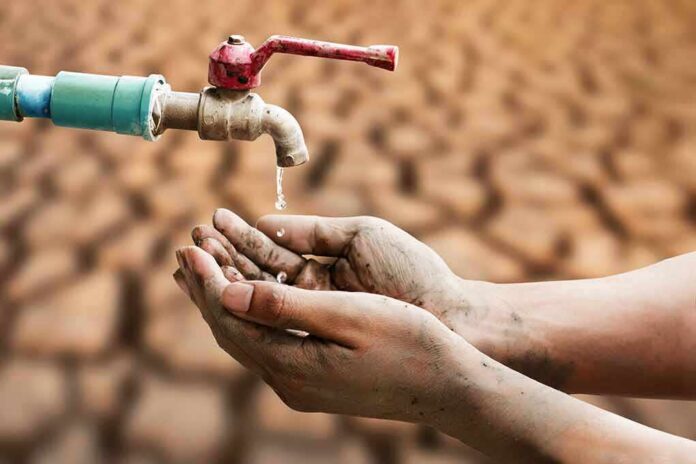
More than 2 billion people on this planet cannot turn on a tap and trust what comes out.
Quick Take
- A new documentary, “Why The World Is Running Out of Clean Water,” lays out the scale of global water shortages.
- The World Health Organization (WHO) says 2.2 billion people lacked safely managed drinking water in 2022.
- Farming uses about 70% of the world’s freshwater, far more than homes or factories.
- Roughly 10% of the world lives in countries facing high or severe water stress right now.
A Crisis Measured In Billions, Not Millions
The documentary opens with a number too big to shrug off. The World Health Organization (WHO) reports that 2.2 billion people, more than a quarter of everyone alive, lacked safely managed drinking water as of 2022. That means water available at home, available when needed, and free of contamination. For over a quarter of humanity, one of those three basic conditions fails every single day.
Access is only half the story. Even when water flows, it is not always safe to drink. The World Health Organization’s Africa office estimates at least 1.8 billion people rely on a drinking source contaminated with human waste, a problem tied to roughly 502,000 diarrheal deaths every year. That is a death toll from dirty water alone, larger than many wars, happening quietly and repeatedly.
Where The Water Actually Goes
A common assumption blames showers, dishwashers, and lawns for drying up the planet’s water. The real pressure comes from farming. The United Nations Educational, Scientific and Cultural Organization (UNESCO) reports that agriculture consumes about 70% of global freshwater withdrawals, while industry takes under 20% and households use roughly 12%. Feeding a growing world, not flushing toilets, is the biggest drain on supply.
That imbalance explains why water scarcity hits hardest in regions that grow food for export or struggle with irrigation efficiency. The United Nations’ latest Sustainable Development Goal tracking finds about 10% of the global population lives in countries facing high or critical water stress, with parts of Northern Africa, Western Asia, and Central and Southern Asia exceeding 75% stress levels. These are not abstract statistics. They describe farmers rationing crops and families walking further for water that may still make them sick.
The Pipes And Plants That Fail Quietly
Even water that gets used once often returns to rivers and groundwater dirtier than before, because treatment systems cannot keep up. The United Nations reports that 44% of household wastewater is not properly treated before release, while a 2025 UN-Water factsheet found only 27% of industrial wastewater gets safely treated. That untreated waste flows back into the same rivers and aquifers communities depend on for drinking water tomorrow.
UNESCO’s World Water Development Report adds another layer to the picture: roughly half of the world’s population experiences severe water scarcity for at least part of the year. That phrase, “part of the year,” matters. It means droughts and shortages are not always permanent, but they are recurring enough to disrupt farming seasons, city water rationing, and public health planning on a predictable, repeating basis.
Progress Exists Alongside The Shortage
None of this means the planet is sliding toward a single, uniform breaking point. United Nations data shows 961 million people gained access to safely managed drinking water between 2015 and 2024. That is real progress, built through infrastructure investment and public health campaigns, even as billions still wait their turn. A documentary built around crisis framing should hold both truths at once: serious shortages persist, and measurable gains are happening too.
Why This Hits Home For American Viewers
Americans watching this documentary should see it as a warning about dependence and infrastructure, not just a far-off tragedy. Water systems fail when governments neglect maintenance, mismanage agricultural policy, or let bureaucracy outpace basic engineering. Clean water is not guaranteed by good intentions. It requires funded, accountable systems that actually deliver what they promise, at home and abroad.
The documentary’s title asks whether the world is running out of clean water. The honest answer, backed by the World Health Organization, the United Nations, and UNESCO, is that billions already live as if it has. Fixing that requires naming the real drivers, agriculture, weak treatment systems, and regional stress, rather than treating water scarcity as one single global emergency with one single cause.
Sources:
youtube.com, who.int, un.org, unstats.un.org, afro.who.int