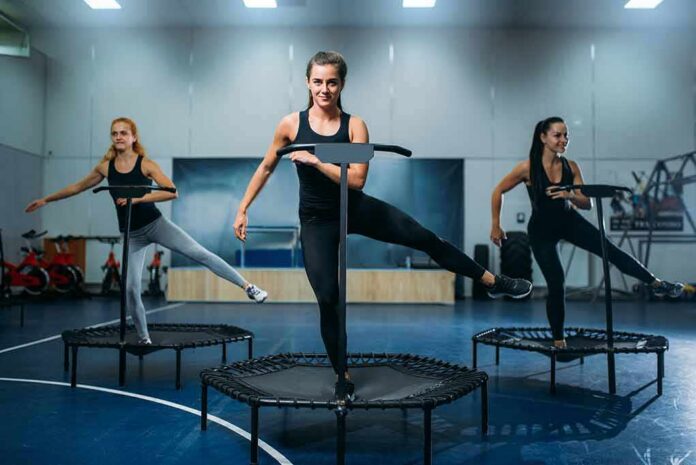
A viral fitness claim says 10 minutes on a mini-trampoline can “build bones,” but the strongest study found better balance and strength—not clear bone gains.
Story Snapshot
- A 12-week mini-trampoline program improved balance, gait, and strength in older women with low bone mass.
- Bone-density changes were small and not clearly better than the control group over 12 weeks.
- NASA’s trampoline study showed higher mechanical stimulus than running but did not measure bone density.
- Guidelines still favor resistance training, impact exercise, and balance work together for bone health.
What the best clinical trial on rebounding actually found
Researchers ran a randomized 12-week mini-trampoline program for older women with osteopenia. The training group improved balance, mobility, gait, strength, and fear of falling more than controls. These gains can cut fall risk, which matters for fractures. Bone results were mixed. Femoral-neck bone mineral density rose within the training group. But the between-group effect did not reach statistical significance over 12 weeks. That means clear bone building versus not training was not proven in this trial.
Secondary reporting of the same study notes about a 1.98 percent rise at the femoral neck and 0.81 percent at the lumbar spine in the exercise group. The control group lost bone at both sites. Those numbers sound promising, but they come from one short study and a secondary summary, and the key group-by-time statistics were not significant. Short trials often lack power to confirm small bone changes, which usually take many months to show.
Why the NASA trampoline paper is not a bone study
A famous National Aeronautics and Space Administration paper compared body acceleration and oxygen use during trampoline jumping and treadmill running. At similar oxygen use, external work and biomechanical stimulus were higher on the trampoline. That shows a plausible loading boost during bouncing. But the study involved eight young men and measured acute mechanics, not long-term bone density or fractures. It does not prove rebounding builds bone over time.
Public claims often stretch the National Aeronautics and Space Administration result into “10 minutes equals 30 minutes of jogging” for bone. That is not what the data show. The 68 percent figure refers to external work at matched oxygen use, not bone density or fracture risk. Conflating short-term lab signals with long-term bone adaptation is a common error in fitness marketing. It fuels hype that later backfires and erodes trust when people look for hard outcomes.
What experts and guidelines say about building stronger bones
Medical commentators reviewing the evidence agree on a narrow point. Rebounding can be a useful way to train balance and strength. It also adds some impact-like loading. But current trials do not show it outperforms proven bone builders. Strong guidance still points to a mix of progressive resistance training, weight-bearing or impact exercise, and dedicated balance work to protect bones and prevent falls. That full program has broader and more consistent support.
For people drawn to rebounding, a practical plan is simple. Keep the mini-trampoline for balance, cardio, and confidence. Add progressive resistance for hips, legs, and back. Include safe, higher-impact steps if your clinician approves. Train two to three days per week for strength and impact, and practice balance often. If you have osteoporosis, ask your clinician which jumps are safe. This approach matches what the best data support today while we wait for longer trials.
Why this debate matters beyond fitness
Americans are tired of health claims that oversell quick fixes while core systems underperform. The mini-trampoline story shows the pattern. A small, positive study and a catchy National Aeronautics and Space Administration stat become bold promises. Then careful readers see the gaps on bone density and fractures. People across the political spectrum share this frustration. They want clear facts, not marketing spin. Honest evidence helps citizens make choices without feeling played by hype cycles.
Sources:
youtube.com, openurl.ebsco.com, ntrs.nasa.gov, frontiersin.org, pmc.ncbi.nlm.nih.gov