Nearly half of American adults are walking around with high blood pressure, and most who have it have no idea.
Story Snapshot
- Mayo Clinic’s Health Matters podcast lays out clear blood pressure numbers: normal is under 120/80, hypertension starts at 130/80, and a crisis is 180/120 or higher.
- Johns Hopkins cardiovascular nurse epidemiologist Dr. Yvonne Commodore-Mensah explains how sodium, sleep, and exercise shape blood pressure readings.
- Home monitoring, done correctly, helps doctors see whether treatment is actually working.
- Lifestyle changes matter, but Mayo Clinic is clear that medication still has a role when those changes aren’t enough.
The Numbers Every Adult Should Know
The podcast breaks blood pressure into plain categories. Below 120 over 80 is normal. Hypertension begins at 130 over 80. A reading of 180 over 120 or higher is a crisis that needs urgent medical attention. Mayo Clinic’s own hypertension guidance backs up these same thresholds, splitting results into normal, elevated, stage 1, and stage 2 categories so patients know exactly where they stand.
Those numbers aren’t just trivia. The Centers for Disease Control and Prevention estimates roughly 120 million American adults, about 48 percent, have hypertension under the current definition. Only about 59 percent of those affected even know they have it. That gap between how common the condition is and how few people recognize it explains why plain-language health content keeps circling back to the basics.
Dr. Commodore-Mensah’s role in the episode matters too. She isn’t an anonymous wellness influencer. She’s a Johns Hopkins researcher explaining clinical thresholds backed by Mayo Clinic’s published diagnostic guidance, which gives the advice real weight instead of recycled internet talk.
What Actually Moves the Numbers at Home
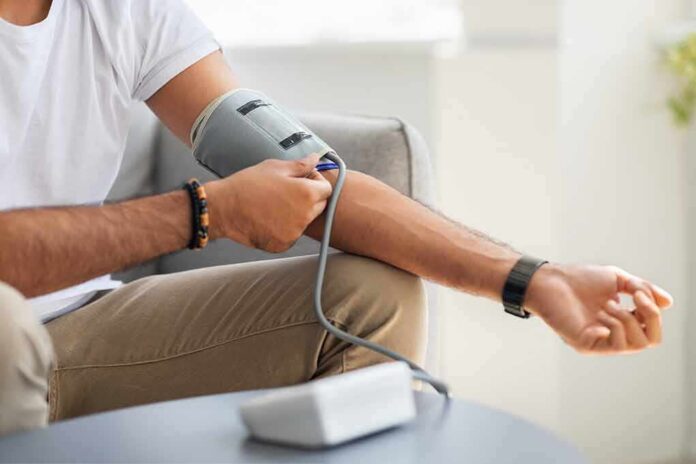
The episode pushes home blood pressure monitoring as a tool, not a gimmick. Mayo Clinic agrees, noting that home readings help a care team judge whether a treatment plan is working. The podcast adds specifics: rest before measuring, use the correct cuff size, support your back and arm, skip caffeine or smoking beforehand, and take more than one reading. Sloppy technique produces misleading numbers.
Sodium gets singled out as a major lever. The episode describes a patient whose blood pressure improved after cutting out canned soup, which can carry close to 1,000 milligrams of sodium in a single can. Mayo Clinic’s own treatment guidance recommends a heart-healthy diet with less salt and urges patients to check food labels closely. American Heart Association research backs this up, showing that cutting sodium from a high-salt diet down to a low-salt one can lower blood pressure by several points in people who already have hypertension.
Exercise and sleep round out the lifestyle picture. Mayo Clinic recommends at least 150 minutes of moderate aerobic activity a week, or 75 minutes of vigorous activity, along with 7 to 9 hours of sleep a night. The podcast frames inactivity and poor sleep as modifiable risk factors, meaning patients have real control over two habits that quietly push blood pressure higher every day they go unaddressed.
Medication Still Has a Place
None of this advice tells patients to ditch their prescriptions. Mayo Clinic states plainly that when lifestyle changes don’t bring blood pressure under control, a healthcare professional may recommend one or more medicines. The podcast echoes that caution, warning patients not to stop medication over side effects without talking to their doctor first. That’s a responsible line, and it matters in an era where lifestyle advice sometimes gets twisted into “throw out your pills” messaging online.
The framing lines up with common sense. Nobody disputes that eating less salt, moving more, and sleeping better help the body. But pretending those habits replace medicine for everyone ignores how differently bodies respond, especially for patients with pregnancy-related hypertension, kidney disease, or already dangerously high readings. Mayo Clinic’s own guidance treats lifestyle change and medication as partners, not rivals.
One patient anecdote in the episode, a woman named Carrie diagnosed at 27 who later suffered a heart attack, is not an isolated medical record reporters can independently verify. It’s offered as an illustrative story, not a clinical case study, and listeners should treat it that way. The core clinical guidance around thresholds, monitoring, and treatment, however, lines up directly with Mayo Clinic’s published standards and national guideline statements from the American Heart Association and American College of Cardiology.