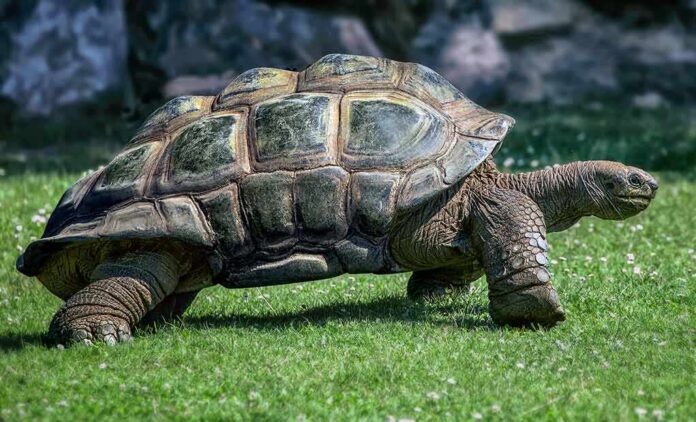
A tortoise born before the Civil War is still alive today, and scientists just found out why his cells refuse to quit.
Quick Take
- Jonathan, a 194-year-old Aldabra giant tortoise, had his full genome and methylome sequenced for a new Science Advances study.
- Researchers found 287 genes with unique genetic variants found only in Jonathan, many tied to DNA repair and cell health.
- His cells showed unusually tidy gene activity in mitochondria, the parts that power the body, resembling a much younger animal.
- Scientists compared Jonathan to other tortoises, including the famous Lonesome George, and used a cheek swab instead of a blood draw.
- The findings offer clues about aging but do not yet prove any treatment or cure for humans.
A Living Fossil Finally Gives Up His Genetic Secrets
Jonathan the tortoise has outlived empires, wars, and nearly every human who ever met him. He lives on the remote island of Saint Helena and is believed to have hatched around 1832. Scientists finally got the chance to study what makes him tick, publishing their results in Science Advances in October 2026. The team sequenced his genome and methylome to hunt for the molecular basis of his extreme longevity.
Instead of drawing blood, which would have been risky for such an old and protected animal, researchers took a simple cheek swab. That gentle sample was enough to map Jonathan’s entire genetic code and study how his genes turn on and off over time. It is a reminder that careful, noninvasive science can still produce serious answers, even when the subject is a 194-year-old national treasure.
287 Genetic Differences Point Toward Cell Repair
Researchers found 287 genes containing variants that exist only in Jonathan, not in the other tortoises studied. Many of these sit inside pathways tied to DNA repair and telomere maintenance, the protective caps on chromosomes that keep cells dividing cleanly instead of falling apart. Cambridge researchers and reporting from The Scientist both point to these pathways as central to understanding why his body has held up for nearly two centuries.
Scientists did not stop at spotting the differences. They used a computer modeling tool called AlphaFold2 to predict how each of the 287 variants might change the shape and function of its protein. That step matters because having a unique gene variant does not automatically mean it does anything useful. The modeling gives researchers a map of which variants are worth chasing down with real lab experiments next.
His Mitochondria Look Decades Younger Than His Shell
Perhaps the most striking finding involves Jonathan’s mitochondria, the tiny structures inside cells that generate energy. Vanderbilt University Medical Center reported that the gene switches controlling mitochondrial energy production showed a remarkably youthful “orderliness”. Researchers measured something called methylation entropy, essentially a scramble score for how genes are regulated, and found Jonathan’s mitochondrial and RNA-processing genes stayed unusually tidy.
Low entropy in that system was linked to high-fidelity gene expression, meaning his cells were still reading instructions accurately instead of making the sloppy mistakes that usually pile up with age. That pattern suggests a biologically sensible way his body may have protected itself from the wear and tear that eventually breaks down energy production in aging animals. It is an association worth taking seriously, even as researchers stop short of calling it proven causation.
Why One Tortoise Cannot Rewrite Human Medicine Yet
Jonathan is one animal, and that limits how far these findings can travel. Researchers compared him against only a handful of other tortoises, including the famously solitary Lonesome George, who vary in age, species, and life history. That small, uneven comparison group makes it hard to prove that Jonathan’s variants caused his long life rather than simply existing alongside it by chance.
This pattern is not new to tortoise science. A 2018 genomic study of giant tortoises and Lonesome George similarly flagged DNA repair genes and cancer-related genes as candidate longevity factors, while treating them as leads rather than confirmed causes. The honest, responsible reading of Jonathan’s results follows that same tradition: real genetic clues worth investigating further, not a finished anti-aging formula ready for a pharmacy shelf.
What Comes Next for Longevity Science
The next real test is replication. Scientists need to sequence more Aldabra tortoises across different ages to see if Jonathan’s 287 variants actually show up more often in the longest-lived animals. Lab experiments on those specific genes, rather than computer predictions alone, would show whether they truly boost DNA repair or mitochondrial performance, or whether they are just interesting coincidences riding along in his DNA.
Common sense says celebrate the discovery without overselling it. A 194-year-old tortoise surviving on a remote island has handed scientists a rare, real biological puzzle piece. Turning that piece into a human therapy will take years of careful, unglamorous lab work, not a headline promising people will live to 200 because one very old reptile did.
🐢 A 194-year-old tortoise is revealing how to age slowly
Jonathan, an Aldabra giant tortoise believed to have hatched in 1832, is the oldest known living land animal. In a study published in Science Advances, researchers found his epigenome — the system controlling which genes… pic.twitter.com/YwaDppvVxJ
— Ankit V (@AnkitV252) November 23, 2026
For now, Jonathan remains exactly what he has always been: a patient, slow-moving reminder that nature sometimes holds answers science is only beginning to read.
Sources:
sciencedaily.com, cnn.com, scientificamerican.com, science.org, 404media.co