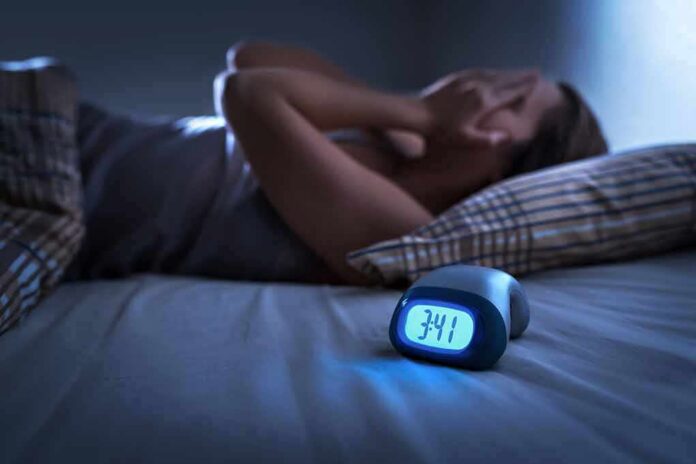
Stressful days really do rearrange your sleep while you’re unconscious, and a new seven-day study just measured exactly how.
Quick Take
- A seven-day study of 21 people in Jerusalem tracked daytime stress and nighttime sleep stages using a wearable EEG headband.
- High-stress days were linked to a 6.57 percentage-point jump in REM sleep and a 5.74 percentage-point drop in deep N3 sleep.
- Researchers used a stress-detection algorithm paired with wearable sensors rather than a simple sleep diary.
- The study was small and short, so the findings point to a pattern worth watching, not a final answer.
What The Sleep Study Actually Found
Researchers fitted 21 volunteers in the Jerusalem area with the Dreem Headband, a wearable device that reads brain activity through electroencephalography. For seven straight days, the device tracked how participants slept each night. At the same time, a psychophysiological stress-detection algorithm logged how stressed each person felt during the day.
The team then compared nights that followed low-stress days with nights that followed high-stress days. When daily stress moments jumped from the 10th percentile to the 90th percentile, REM sleep rose by 6.57 percentage points. Deep N3 sleep, the stage tied to physical recovery, dropped by 5.74 percentage points over that same comparison.
That tradeoff matters because N3 sleep is widely seen as the body’s deepest repair stage. Less of it, paired with more REM, could help explain why a rough day at work sometimes leads to a night of vivid dreaming followed by a groggy, unrefreshed morning. The study did not directly measure next-day tiredness, but the stage shift itself lines up with that common complaint.
Why Wearable Brain Tracking Changes The Picture
Older stress-and-sleep research often leaned on morning questionnaires asking people to recall how they slept. This study skipped the guesswork. Because the Dreem Headband records actual brain-wave activity, researchers could sort sleep into real stages, N1, N2, N3, and REM, instead of relying on memory.
Wearable EEG headbands generally track sleep stages with reasonable accuracy compared to hospital-grade sleep labs, though no consumer device matches a full clinical setup exactly. That tradeoff is the price of running a study in people’s actual homes over multiple nights rather than in a lab for one. For a seven-day field study, continuous at-home brain monitoring is still a meaningful upgrade over a diary.
The design also let researchers pair each day’s stress level with that same night’s sleep, inside the same person, repeated across a week. That kind of matched, repeated-measures setup is harder to pull off than a one-time survey and gives the stress-REM-N3 link more weight than a single snapshot would.
What This Study Does Not Yet Prove
Twenty-one people from one metropolitan area is a small group. The result is a real statistical pattern worth taking seriously, but it is not yet proof that stress alone causes the shift, nor that it applies evenly across ages, health conditions, or cultures. Other daily-life factors, like caffeine, screen time, or exercise, could also be in play.
The stress measurement itself came from an algorithm reading physiological signals, not a therapist’s assessment. It is a solid proxy, but it is still a proxy. And the study’s seven-day window cannot tell us whether this pattern repeats for a single rough week or builds up over months of chronic pressure. Scientists in related research have long noted that stress and sleep quality are connected in both directions, which fits this new data without settling every open question.
Better stress management starts the night before. Build restorative sleep with mindful daytime habits—and less screen time before bed. #SleepHealth #StressManagement pic.twitter.com/CPBx7ahjNz
— Kwadwo Kyeremanteng (@kwadwo777) November 24, 2026
For anyone who drags through mornings despite a full eight hours in bed, this research offers a plausible, measurable reason why rest alone doesn’t always equal recovery. Good sleep habits still matter. But managing daytime stress, not just protecting bedtime, may be the missing piece worth testing in your own routine before reaching for another gadget or supplement.
Sources:
mindbodygreen.com, pubmed.ncbi.nlm.nih.gov, pmc.ncbi.nlm.nih.gov