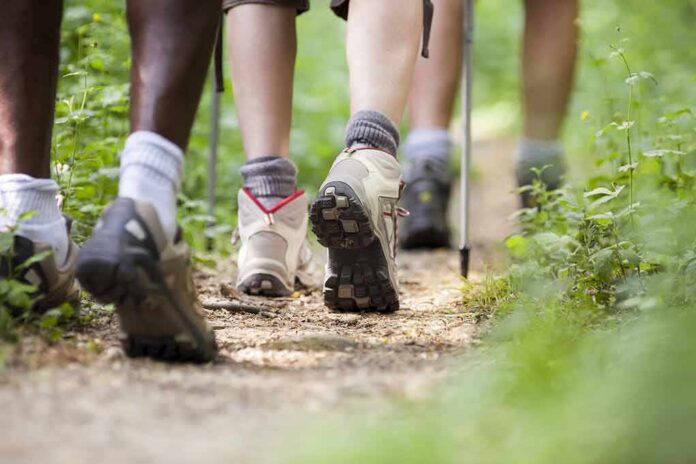
A single 15-minute walk could cut your heart disease risk more than scattering the same steps across your whole day.
Quick Take
- A new study followed 33,560 adults in the UK Biobank database who averaged 8,000 steps or fewer per day
- People who walked in bouts of 15 minutes or longer had far lower rates of cardiovascular disease than those who walked in short bursts under 5 minutes
- Cumulative cardiovascular disease risk hit 13.03% in the short-walk group versus roughly 4.39% in the long-walk group over 9.5 years
- Researchers used wrist-worn fitness trackers to measure real walking patterns, not self-reports
What The Study Actually Found
Researchers published the findings October 28 in Annals of Internal Medicine, tracking adults who were free of cardiovascular disease and cancer at the start. Participants wore devices that recorded every step for up to seven days. Scientists then sorted people into four groups based on how long their typical walking sessions lasted: under 5 minutes, 5 to 10 minutes, 10 to 15 minutes, and 15 minutes or more.
The results were stark. People who mostly took short walks under five minutes had a cumulative cardiovascular disease risk of 13.03% after 9.5 years. Those who typically walked 15 minutes or longer saw that risk drop dramatically, landing in the low single digits. All-cause mortality followed the same pattern, falling from 4.36% in the shortest-bout group down to about 0.80% among the longest walkers.
Why Bout Length Seems To Matter So Much
This study focused specifically on adults who were not hitting typical activity targets, averaging 8,000 steps a day or fewer. That detail matters. The findings suggest that for people who aren’t naturally active, how you accumulate your steps may count just as much as how many you take. A sustained 15-minute walk likely pushes the heart and lungs to work harder for longer than a quick dash to the mailbox.
Cardiologists reviewing the research noted that longer walking bouts probably demand more continuous cardiovascular effort, similar to how interval training differs from casual movement. Short bursts of walking still count toward daily step totals, but they may not challenge the heart enough to produce the same training effect. The body seems to reward sustained effort, not just total movement.
How This Fits With Decades Of Walking Research
This isn’t the first time scientists have debated bout length. Older federal guidelines once insisted that exercise only “counted” if done in chunks of at least 10 minutes. That rule was later dropped when newer research showed that activity of any length contributes to health, prompting updated guidance acknowledging shorter bursts still help. This new study doesn’t contradict that shift, but it does suggest longer bouts may offer an added edge for people who are under-active.
Other research backs the general idea that walking volume and intensity both matter. A separate meta-analysis found that adults who took the most daily steps overall had 40% to 53% lower mortality risk compared with the least active group. Walking pace has also shown up repeatedly as a strong predictor of heart outcomes, sometimes rivaling total step count in its impact on long-term survival.
What This Means For Daily Habits
The practical takeaway is simple and useful for busy adults juggling work, family, and everything else life throws at them. Instead of chasing a step counter all day with errands and hallway laps, carving out one dedicated 15-minute walk may do more for your heart. It’s a realistic swap, not an overhaul, and it fits into a lunch break or a walk around the block after dinner.
This is an observational study, meaning it shows a strong association rather than definitive proof that bout length alone causes the risk reduction. Still, the pattern held consistently across thousands of participants and nearly a decade of follow-up, giving everyday walkers a clear, low-cost target to aim for starting today.
For Americans who value practical, common-sense health advice over expensive gym memberships or trendy supplements, this finding lands well. It confirms what grandparents always said: get outside and walk, and walk long enough to feel it. No app subscription required, no gadget necessary beyond a decent pair of shoes and a bit of daily discipline.
Sources:
pubmed.ncbi.nlm.nih.gov, sciencedaily.com, health.harvard.edu, eurekalert.org, medscape.com, medicalnewstoday.com, biobank.ndph.ox.ac.uk, iris.who.int, cdc.gov, pure-oai.bham.ac.uk