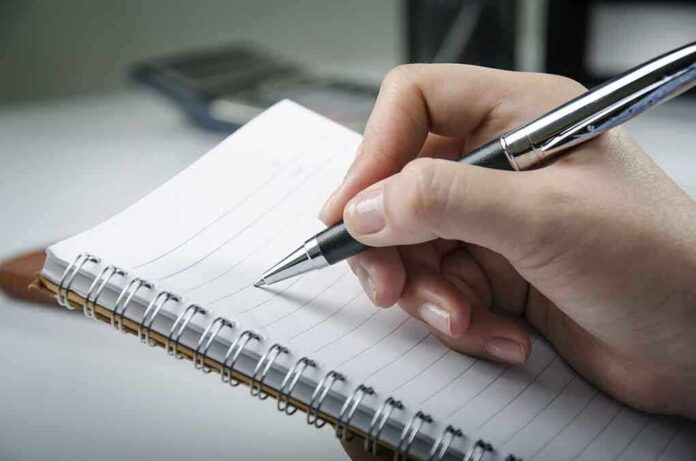
Your brain lights up in ways a keyboard simply cannot match the moment a pen touches paper.
Quick Take
- A Norwegian study using high-density EEG found handwriting triggers far more widespread brain connectivity than typing.
- Researchers recorded activity in 36 university students and saw theta and alpha wave patterns tied to memory and learning.
- The effect shows up in brain regions linked to movement, vision, and memory working together during handwriting.
What Scientists Found When They Watched The Brain Write
Researchers at the Norwegian University of Science and Technology strapped a 256-sensor EEG cap onto 36 college students and told them to write. Some used a pen. Others typed the same words on a keyboard. The pen group showed something the typing group didn’t: widespread coordination between brain regions handling motor control, vision, and memory, all firing together like a coordinated team.
The study, published in Frontiers in Psychology, measured theta and alpha wave connectivity, the brain’s electrical signatures tied to encoding new information into memory. Handwriting produced what the researchers called “widespread theta/alpha connectivity coherence patterns” between hubs in the parietal and central regions of the brain. Typing barely stirred the same networks.
Why The Pen Beats The Keyboard For Deep Learning
The reason comes down to complexity. Forming letters by hand demands fine motor coordination, visual tracking, and timing all at once. That layered effort forces the brain to build richer, more durable neural connections than the repetitive, low-effort tap of a key. Scientific American reported the same pattern: students writing by hand showed higher electrical activity across regions tied to movement, sensory processing, and memory, all firing in tandem.
Edutopia’s review of the data described handwriting as creating “more durable” memory traces because it engages so many systems simultaneously. That matters for anyone trying to actually remember what they wrote, not just produce a record of it. The brain isn’t just storing words. It’s building a fuller sensory map of the experience of writing them.
What This Means For Parents, Students, And Anyone Over Forty
National Public Radio’s coverage of the classroom angle found something parents have long suspected: kids who trace letters by hand recognize and understand them faster and longer than kids who type them. That’s not nostalgia talking. That’s measurable brain data challenging decades of schools phasing out cursive and handwriting instruction in favor of tablets and typing curricula.
For adults, the takeaway is simpler still. If you want to remember something, whether it’s a grocery list, a sermon note, or a grandchild’s birthday, put it on paper. Science News reported that handwriting boosts connectivity in brain regions “implicated in learning and memory” even in college-age adults, decades past the classroom years where handwriting habits usually form. The old-fashioned notepad may be the smartest tool in the room.
Sources:
pmc.ncbi.nlm.nih.gov, journals.sagepub.com, repository.lsu.edu, 2024.sci-hub.se, ui.adsabs.harvard.edu, nbcnews.com, edutopia.org, scientificamerican.com, frontiersin.org