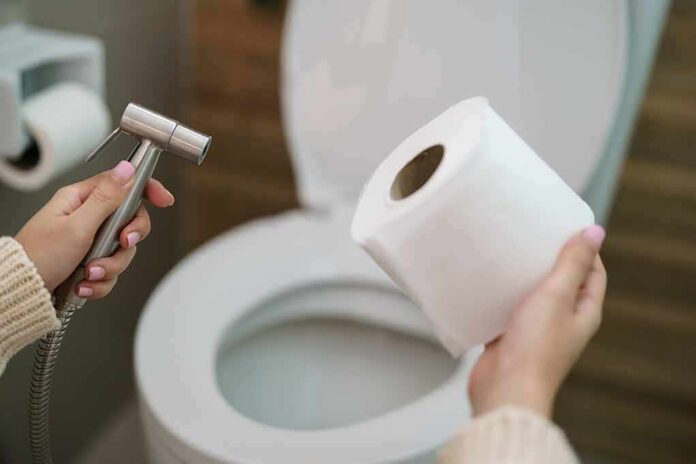
The health question around toilet paper is not whether chemicals can be detected — they can — but whether the trace amounts plausibly delivered by a few seconds of skin contact constitute a meaningful human exposure.
At a Glance
- Peer-reviewed testing has detected PFAS in toilet paper, led by 6:2 diPAP; the quantified contribution to wastewater is real but modest in North America.
- Detection does not prove intentional addition; supply-chain contamination likely explains many low-level findings.
- Dermal exposure from brief contact is, based on current evidence, a minor pathway relative to ingestion and inhalation.
- Recycled fibers can carry bisphenols like BPA; measured levels in paper products are generally low and their clinical significance remains uncertain.
What the science actually shows: detection, compounds, and pathways
A 2023 peer‑reviewed study cataloged per‑ and polyfluoroalkyl substances (PFAS) in toilet paper across multiple regions and traced their appearance in wastewater sludge; the most prevalent analyte was 6:2 diPAP, a fluorotelomer phosphate diester used in some paper and packaging applications. By pairing product measurements with usage estimates, the authors calculated that toilet paper contributed between 6.4 and 80 micrograms per person per year of 6:2 diPAP to wastewater systems, and on the order of a few percent of this compound in U.S. and Canadian sewage streams — higher in some European locales with different product mixes and infrastructure. Those numbers situate toilet paper as a contributor to environmental PFAS loads, not the dominant one in North America.
Two points flow from that work. First, the exposure pathway is clear: residues on paper migrate to sewage with use, where PFAS persistence becomes a treatment and sludge‑management problem. Second, the data characterize presence and environmental flux; they do not link toilet paper use to clinical outcomes. That distinction is not academic — it is the line between analytical chemistry and human health effect.
Why presence is not the same as risk: dose, route, and bioavailability
Risk is the product of hazard and exposure. PFAS are a large class; some are well‑studied hazards. But exposure magnitude and route matter. For consumer products, the principal human burden usually derives from ingestion (contaminated food and water) and inhalation (indoor dust), with dermal uptake generally a smaller fraction when it occurs at all. Expert commentary has consistently underscored this hierarchy for everyday items like toilet paper, emphasizing that brief skin contact typically delivers far less exposure than chronic ingestion or inhalation pathways and that consumer‑product levels are very small and not clearly linked to cancer in this use case. That stance aligns with broader dermal‑exposure literature indicating that for many PFAS, skin absorption is limited compared with oral intake under real‑world conditions.
Bisphenols such as BPA tell a similar story with a different route. The concern with recycled fiber is plausible chemistry: thermal receipt paper and some label stocks use bisphenol developers; when those enter recycling streams, residues can appear in new paper products. Reporting has flagged this pathway for recycled tissues. At the same time, physicians quoted in mainstream coverage have characterized the levels measured in paper as generally low and the clinical significance uncertain — a succinct statement of where the science sits today for this specific product category.
What brand tests and advocacy add — and what they don’t
Advocacy and consumer‑testing projects have broadened the conversation by screening named brands for “organic fluorine” — a proxy that can signal PFAS — and reporting detections in a minority of products, sometimes including bamboo or recycled lines. These efforts raise transparency pressure and have documented heterogeneity across the market. They also use methods and markers that are intentionally coarse: total organic fluorine is not a PFAS speciation, and parts‑per‑million findings in a solid matrix do not translate cleanly to absorbed human dose. Even when the lab is certified and the detection is sound, health inference still requires exposure modeling and toxicology — steps these brand snapshots typically do not perform. As a result, they are useful for framing questions and prioritizing follow‑up, less so for quantifying personal risk.
By contrast, the peer‑reviewed ACS study provides compound‑specific identification (e.g., 6:2 diPAP) and an exposure‑to‑environment estimate anchored to usage. It shows that toilet paper is part of the PFAS throughput in wastewater and quantifies its share in several contexts — about a few percent for a key diPAP in North America — which is valuable for utilities and regulators managing sludge and effluent. For individual users, however, the study stops short of a dose‑response assessment for skin contact because that was not its aim.
Manufacturing reality: why low-level residues show up
Most paper mills run complex, globalized supply chains. Additives, recycled feedstocks, coatings used earlier in a fiber’s life, and even packaging can introduce trace fluorinated or phenolic chemistries. When low‑level PFAS are detected in personal‑care papers, experts familiar with paper chemistry have emphasized that intentional addition is unlikely; background contamination in the supply chain is the more probable source at the levels being reported. That is consistent with what independent testing campaigns now say about toilet paper and other hygiene products: trace detections are common, but seldom evidence of purposeful formulation for consumer‑contact performance.
Where the genuine uncertainties remain
Three evidence gaps keep this question open. First, there is no published, product‑specific dermal transfer and absorption study for toilet paper that measures residue on skin during real wiping, follows it into systemic circulation, and compares the resulting absorbed dose to toxicological reference values for the actual compounds present. Second, data on BPA (and BPS) in recycled toilet paper are piecemeal; a contemporary, method‑rigorous survey quantifying bisphenols in today’s retail lines would clarify how often the recycling pathway matters. Third, there is no standardized disclosure regime for additives and residuals in tissue products, leaving consumers and clinicians to triangulate across marketing claims, sporadic tests, and generalizations from adjacent categories.
Practical guidance for consumers while the science matures
If you want to minimize uncertain exposures without sacrificing common sense, a few grounded steps help. Favor unscented, dye‑free rolls; these avoid fragrance mixes that add unrelated irritants. If you prefer recycled fiber for environmental reasons, diversify: alternate with non‑recycled tissue or a bidet to reduce contact frequency while retaining waste‑stream benefits. If your skin is reactive, trial softer, lint‑low products and avoid embossed, ultra‑textured sheets that increase friction. For households with sensitive users, consider chlorine‑free processed options; although modern elemental‑chlorine‑free bleaching limits dioxin formation in mainstream tissues, reducing additive complexity can simplify irritation troubleshooting. Above all, remember exposure arithmetic: what you drink and eat will dominate your PFAS intake; spend your energy there first.
Sources:
theguardian.com, thenationalnews.com, naturopathy-uk.com