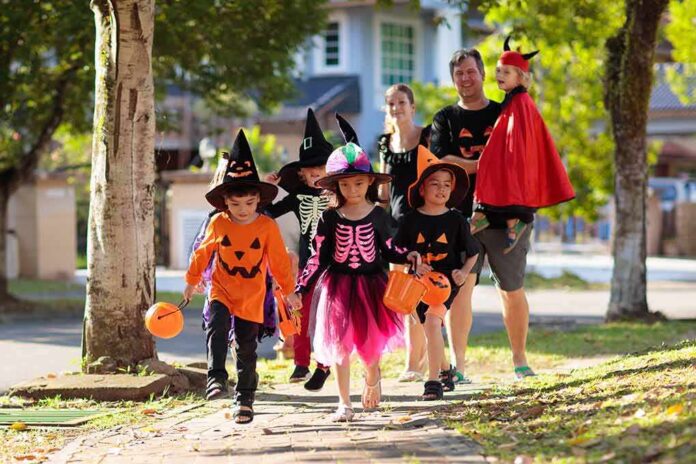
Every October 31st, the sidewalk turns into one of the most dangerous places in America for a child to stand.
Quick Take
- Federal transportation officials urge adult supervision, reflective gear, and crosswalk use for trick-or-treaters this Halloween.
- Research covering 42 years of crash data found pedestrian deaths jump 43 percent on Halloween night.
- Children ages 4 to 8 face roughly ten times their normal risk of being struck and killed while walking that night.
- Most fatal incidents cluster between 5 and 8 p.m., right when trick-or-treating peaks.
A Dangerous Night Hiding Behind A Fun Holiday
Halloween feels harmless. Kids in costumes, candy bags, porch lights glowing. But the numbers tell a grimmer story. Researchers analyzing four decades of national crash data found pedestrian deaths spike sharply every October 31st, concentrated in the early evening hours when children are most likely to be outside and drivers are least likely to see them coming.
The danger isn’t evenly spread. Children between ages 4 and 8 face about ten times their usual risk of being killed while walking on Halloween night compared to other nights of the year. That single statistic explains why safety officials repeat the same warnings every autumn, even though the advice rarely changes.
What Federal And State Officials Actually Recommend
The U.S. Department of Transportation issues a Halloween safety advisory every year, and it isn’t complicated. Adults should supervise children under 12. Kids should carry flashlights or wear reflective materials. Everyone should use crosswalks instead of darting between parked cars, and look left, right, then left again before stepping into any street.
Florida’s Department of Highway Safety and Motor Vehicles echoes nearly identical guidance, pushing sidewalks over streets, bright or reflective clothing, and flashlights for every trick-or-treater. The agency’s own data shows Halloween fatalities have climbed in recent years, which is exactly why the state keeps the message simple and repeats it loudly every fall instead of assuming parents already know.
Why The Same Four Tips Keep Getting Repeated
Nighttime visibility is the core problem. One analysis citing federal crash data found 76 percent of pedestrian deaths happen after dark, which lines up perfectly with Halloween’s dusk-to-night trick-or-treating window. Masks limit peripheral vision, dark costumes blend into shadows, and drivers simply don’t see small bodies crossing until it’s too late.
That’s why flashlights and reflective tape aren’t throwaway suggestions. They’re the single cheapest fix for the biggest driver of Halloween pedestrian deaths. A five-dollar reflective strip or a phone flashlight can make a child visible to an oncoming driver from a hundred feet further away, buying precious seconds that matter when a car is already moving.
The Numbers Behind The Warning
A widely cited study in JAMA Pediatrics looked at 42 years of fatal traffic data nationwide and found 608 pedestrian deaths occurred during Halloween evenings, compared to 851 across twice as many matched comparison nights. After adjusting for how much time people actually spend outside, the researchers calculated pedestrian fatality risk runs 43 percent higher on Halloween than on an ordinary night.
That works out to roughly four extra pedestrian deaths nationwide on an average Halloween, concentrated almost entirely in that narrow 5 to 8 p.m. window when porch lights come on and streets fill with costumed kids. The pattern has held steady for decades, which is precisely why the safety advice hasn’t needed to change.
None of this means Halloween should be feared or skipped. It means the holiday’s real danger isn’t ghosts or haunted houses, it’s ordinary traffic meeting reduced visibility at the exact hour families are out walking together. Supervision, light, and sidewalks remain the simplest defense against a risk that’s been measured and documented for years.
Sources:
coastalpoint.com, parentdiaries.com, childrenssafetynetwork.org