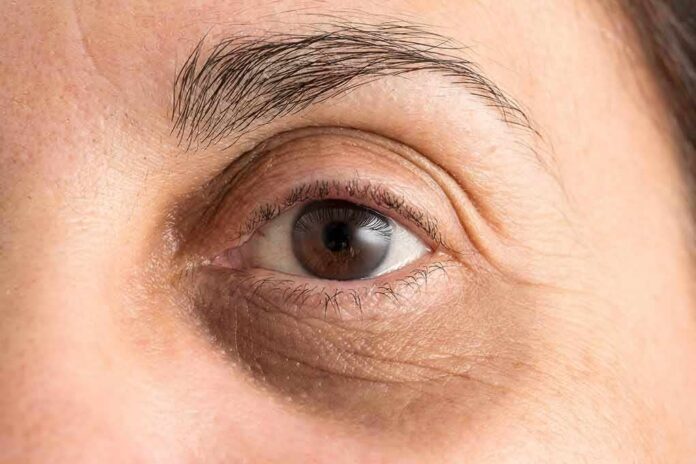
Tired-looking eyes aren’t always about a bad night’s sleep. Sometimes they’re a sign of a real eyelid condition doctors call blepharoptosis.
Quick Take
- Doctors recognize a “tired appearance” as a classic symptom of acquired blepharoptosis, a drooping of the upper eyelid.
- The most common cause is age-related stretching of the muscle that lifts the eyelid.
- A 2024 study found ptosis in at least one eye in nearly three out of four eye-care patients examined.
- Surgery and a prescription eye drop both offer proven ways to lift the lid, though results vary by cause and severity.
What Doctors Mean By A Tired Look
Eye doctors have a name for the droopy, sleepy look some people develop as they age: blepharoptosis, or ptosis for short. The American Academy of Ophthalmology says patients often describe the affected eye as smaller, tired-looking, and sometimes blocking part of their vision or causing headaches. That’s not just a cosmetic complaint. It’s a documented symptom doctors look for during an eye exam.
Ptosis happens when the upper eyelid sags lower than it should when the eye is open normally. A 2021 medical review defines this drooping as the hallmark of the condition, and notes that the type people develop later in life, called acquired ptosis, is by far the most common form. It’s different from the ptosis babies are sometimes born with, which stems from a different cause entirely.
Why The Eyelid Starts To Sag
The most frequent reason for this droop has nothing to do with being sleepy. It’s mechanical. The muscle that lifts your eyelid, called the levator, is attached to the lid by a tendon-like structure. Over the years, that connection can stretch, loosen, or pull away. Doctors call this aponeurotic ptosis, and it’s the leading cause of mild-to-moderate droop in older adults.
Doctors don’t just eyeball the problem. The Academy’s clinical guidance calls for measuring lid height, checking how well the muscle itself still functions, and examining pupil size, eye movement, and facial sensation. That last step matters because a drooping eyelid can occasionally point to something more serious, like a nerve or muscle disorder, rather than simple aging.
Just How Common Is This?
A 2024 study of United States eye-care patients found something striking. Ptosis showed up in at least one eye in 73.4 percent of patients examined, and 25.5 percent had noticeably uneven upper eyelids. That’s a clinic population, not a random sample of the general public, so it doesn’t mean three-quarters of all adults have the condition. But it does show how often doctors are catching it once patients walk through the door. Separate research estimates that somewhere between 4.7 percent and 13.5 percent of adults have some form of acquired ptosis, depending on how researchers define and measure it.
What Can Actually Be Done About It
The good news for anyone staring at tired eyes in the mirror: treatments exist, and they’re well established. For patients whose lifting muscle still works reasonably well, surgeons can perform a levator advancement, essentially re-tightening the stretched tendon. When the muscle has weakened significantly, doctors may use a frontalis sling procedure instead, which borrows lifting power from the forehead muscle. The EyeWiki reference guide also describes internal procedures that tighten muscle from behind the eyelid.
For people who want a non-surgical option, oxymetazoline eye drops, sold under the brand name Upneeq, offer a temporary lift by stimulating a different small muscle in the eyelid. It’s worth remembering that not every case responds the same way. Treatment choice depends on what’s causing the droop, how severe it is, and the patient’s overall eye health, not a one-size-fits-all fix.
The Bottom Line For Anyone Noticing The Look
A persistently tired appearance deserves more than concealer or extra coffee. It can be a legitimate medical finding, one doctors can measure, diagnose, and in most cases treat. An eye exam that checks eyelid height and muscle strength can separate ordinary aging from something that needs closer attention, and it can point toward a real solution instead of guesswork.
Anyone noticing persistent droopiness, especially if it affects vision or comes on suddenly, should get evaluated by an eye doctor rather than assuming it’s just fatigue.
Sources:
mindbodygreen.com, aao.org, eyewiki.aao.org, pmc.ncbi.nlm.nih.gov